Chitting potatoes means letting seed potatoes sprout before you plant them. You set the tubers in a cool, bright, frost-free room for 2 to 4 weeks until short, sturdy sprouts grow from the eyes. Then, if a tuber is large, you cut it into seed pieces so one tuber can plant several spots. Chitting is optional, not mandatory. Cutting is only needed for large tubers. Small tubers can be planted whole. This guide covers chitting potatoes step by step, then cutting and curing, so you can decide what your seed needs.
Table of Contents
What is chitting in simple terms?
Chitting potatoes is pre-sprouting. A seed potato is a tuber with eyes, and each eye can grow a sprout. When you chit, you give those eyes light and time so they grow short, green, sturdy sprouts before the tuber goes into the ground.
Chitting works with seed tuber dormancy: after harvest, a tuber rests and its eyes stay quiet, then wake up and sprout. Chitting gives that process a head start in light.
Do you have to chit potatoes? No. You can plant seed potatoes straight from the bag without chitting, and they will still grow. Gardeners choose chitting potatoes because it gives earlier emergence, more even growth and a slightly earlier harvest, especially for early varieties. If you are short on time or space, skip chitting and plant directly.
How to chit potatoes indoors
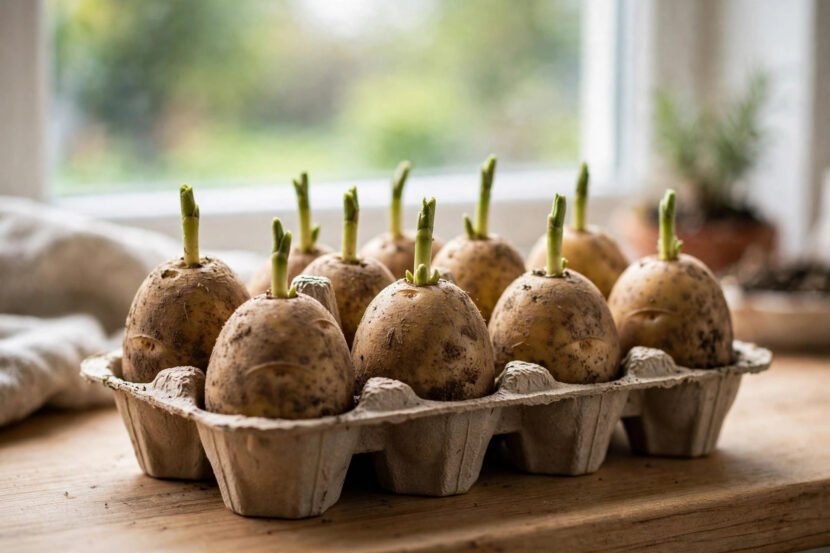
The egg carton method is the simplest way of chitting potatoes indoors. You need seed potatoes, an egg carton or a shallow tray, and a cool, bright, frost-free room.
- Start 2 to 4 weeks before planting. Work back from your planting date. If you plan to plant 2 to 4 weeks before your last expected spring frost, start chitting 2 to 4 weeks before that.
- Pick firm, healthy seed potatoes. Use certified seed potatoes from a garden centre or seed supplier. Certified seed is grown to reduce disease, while grocery store potatoes may carry disease and are often treated to stop sprouting. Throw away any tuber that is soft, shriveled or rotten.
- Set the tubers eyes up. Put each tuber in an egg carton cup or a shallow tray with the end that has the most eyes facing up. Keep the tubers in a single layer so light reaches all of them.
- Put them in cool, bright light. A frost-free bright room is ideal, such as a cool windowsill or a garage with a window. The room should be cool, roughly 50 to 60 degrees Fahrenheit, and bright but out of direct hot sun.
- Wait and check. Sprouts should appear within a week or two. Chitting potatoes in a warm room gives long, pale sprouts that break easily, so keep the room cool.
How long does chitting take? 2 to 4 weeks, depending on the variety and the temperature. Cooler rooms are slower.
Where do you chit potatoes? Any cool, bright, frost-free place works for chitting potatoes, such as a windowsill, a bright porch or a garage with a window. Avoid a hot, sunny windowsill and avoid a dark shed or cupboard. Cool and bright is the rule.
How to cut seed potatoes
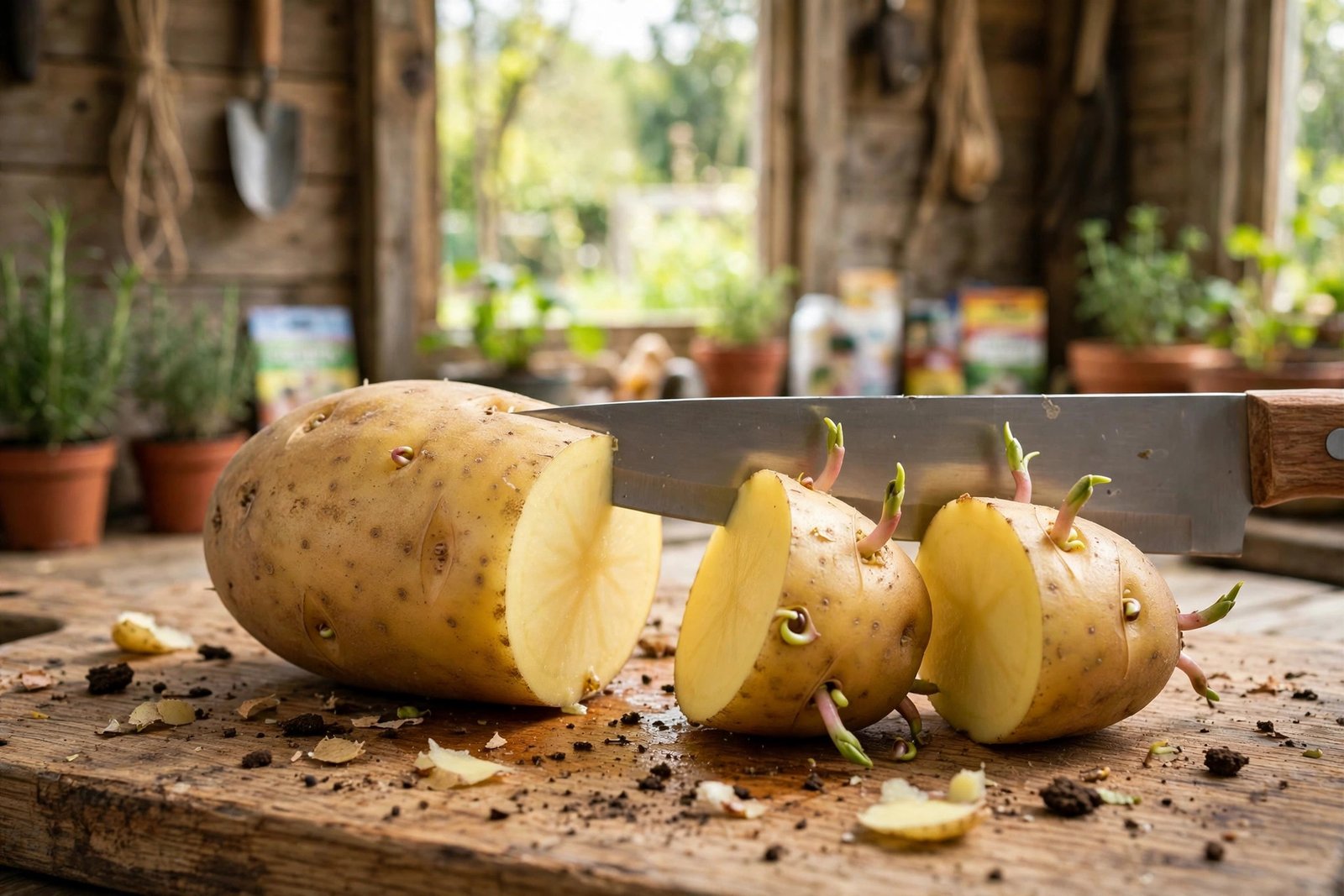
Cutting seed potatoes means dividing a large tuber into pieces so one tuber can plant several spots. Cutting comes after chitting potatoes, and only for large tubers. Each piece is called a seed piece, and each piece must have at least one eye, because the eye is where the sprout grows. Cut only large tubers. Small tubers about the size of an egg can be planted whole.
- Wait until a few days before planting. Cut seed potatoes 1 to 3 days before you plant, not weeks ahead. Freshly cut pieces need time to heal, and that healing is called curing.
- Use a clean, sharp knife. Wash the knife and your hands first. A clean knife matters, because a dirty blade can spread disease from one tuber to the next.
- Cut each piece to 1.5 to 2 ounces. How big should seed potato pieces be? About 1.5 to 2 ounces each, the size of a golf ball. Each piece should have 1 to 2 eyes. How many eyes does each seed piece need? At least 1, and 2 is ideal. A piece with no eye will not grow.
- Let the cut pieces dry. Place cut pieces cut side down on a tray in a cool, ventilated spot.
Can you plant a whole seed potato? Yes. Small potatoes can be planted whole, and many gardeners prefer it, because a whole tuber cannot rot from a cut surface. Whole seed is the simplest option.
Can small potatoes be planted whole? Yes. If a tuber is about the size of an egg or smaller, plant it whole. A small piece has little food stored in it, and the young plant needs that food. Seed piece weight is the rule: 1.5 to 2 ounces per piece, whole or cut.
Why cure cut potatoes
Why cure cut potatoes? After chitting potatoes and cutting the large ones, curing is the step that protects the cut pieces. A fresh cut is an open wound, and an open wound rots in cold, wet soil. Curing means letting the cut surface dry and form a callus, a thin, dry skin that seals the piece and keeps rot out.
How long to cure cut potatoes? Let cut seed potatoes dry for 1 to 3 days in a cool, ventilated spot, out of direct sun. The cut surface should feel dry and slightly leathery. Cut surface rot is the most common reason cut seed fails, and curing is the fix.
Use a clean knife, wash your hands and discard any rotten pieces. Do not cut a rotten tuber and use the good-looking half.
Planting your prepared seed
Once chitting potatoes is finished and your seed is cut and cured, planting is straightforward. Plant when the soil 4 to 6 inches deep is consistently 45 to 50 degrees Fahrenheit and workable, usually 2 to 4 weeks before your last expected spring frost. Full timing by USDA zone and last frost date is in our guide on when to plant potatoes. The full planting method is in our guide on how to plant potatoes.
Plant seed pieces 4 to 6 inches deep and 10 to 12 inches apart in rows 30 to 36 inches apart, sprouts up, then cover with 2 to 4 inches of loose soil. The exact depth and spacing chart is in our guide on how deep to plant potatoes. Water lightly after planting. When plants are 6 to 8 inches tall, hill soil around the stems. Hilling keeps tubers covered so sunlight cannot turn them green. Green potatoes contain solanine, and our guide on are green potatoes safe to eat explains the rule. For pots and grow bags, see our guide on how to grow potatoes in containers.
Quick reference table
| Step | What to do |
|---|---|
| Chitting | Cool, bright, frost-free room, 2 to 4 weeks, eyes up |
| Sprout length | About half an inch to an inch, short and sturdy |
| Cutting | 1 to 3 days before planting, clean knife |
| Seed piece size | 1.5 to 2 ounces, 1 to 2 eyes per piece |
| Curing cut pieces | 1 to 3 days in a cool, ventilated spot until the cut feels dry |
| Small tubers | Plant whole, do not cut |
| Planting | Soil 45 to 50 degrees Fahrenheit, pieces 4 to 6 inches deep, 10 to 12 inches apart |
FAQ
What is chitting in simple terms?
Chitting potatoes is pre-sprouting seed potatoes before planting. You set tubers in a cool, bright, frost-free room for 2 to 4 weeks until sturdy sprouts grow.
Can chitting speed up harvest?
A little. Chitting potatoes gives faster emergence, which can bring harvest forward by a week or two. It does not shorten the total season much, but emergence is more even.
Should sprouts face up?
Yes. After chitting potatoes, plant the chitted seed with the sprouts facing up. Sprouts grow upward more easily and the plant establishes faster. Handle chitted seed gently so sprouts do not break off.
Should cut potatoes dry before planting?
Yes. After chitting potatoes and cutting large tubers, let cut pieces dry for 1 to 3 days in a cool, ventilated spot until the cut surface feels dry and leathery. This curing seals the cut and keeps rot out.
What size piece is best?
About 1.5 to 2 ounces per piece, the size of a golf ball, with 1 to 2 eyes. Small tubers about the size of an egg can be planted whole.
Sources and further reading
- University of Minnesota Extension, Growing potatoes in home gardens
- Utah State University Extension, How to Grow Potatoes in Your Garden
- Kansas State University Extension, Growing Potatoes
- North Dakota State University Extension, Dakota Gardener: How to plant potatoes