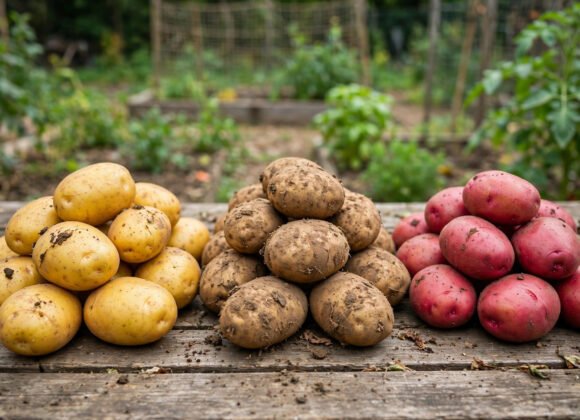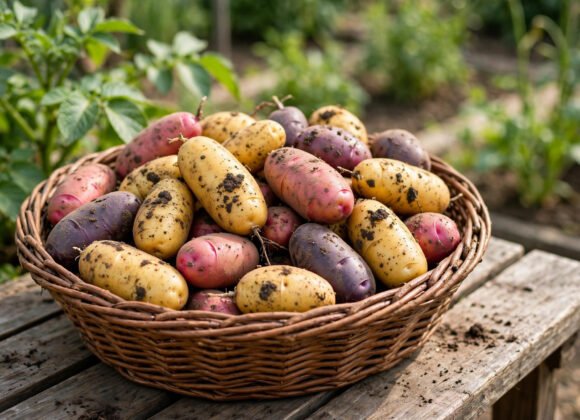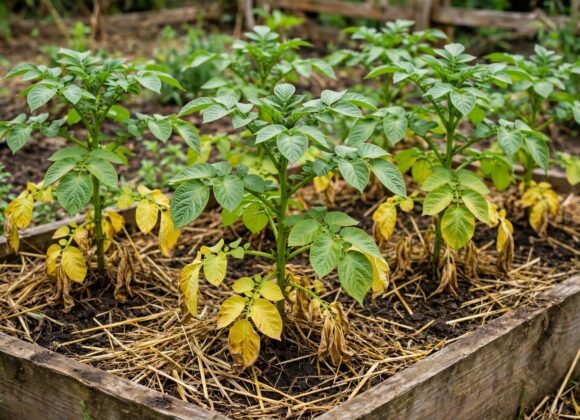
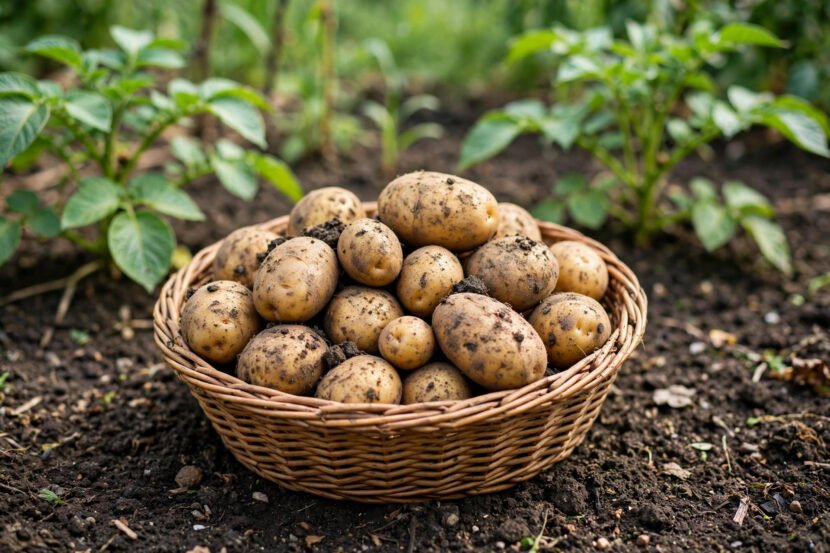
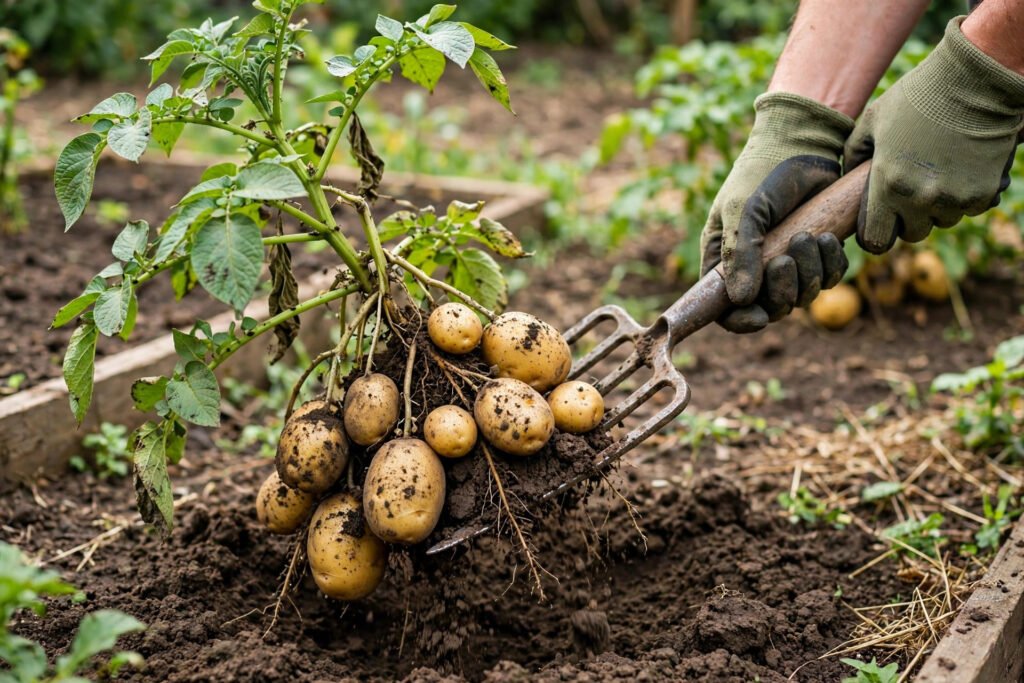
How many potatoes per plant should you expect from your own garden? The honest answer is that most home gardeners harvest about 1 to 5 pounds per plant, which usually works out to roughly 5 to 10 tubers, and the exact number depends on the variety, the spacing, the water and the length of the season. A plant that gets steady water, loose soil and a full season will sit near the top of that range, while a plant that is crowded, dry or dug too early will sit near the bottom, or below it.
This guide gives you realistic numbers, explains what moves the yield up or down, and shows you how to fix the most common reason for a small harvest, which is usually not the variety at all. How many potatoes per plant you get is mostly a result of how the plants were grown, not a fixed number written on a seed packet.
Table of Contents
The short answer on yield
If you want one number to plan around, use 1 to 5 pounds per plant, or about 5 to 10 tubers of mixed sizes. That range covers the varieties most home gardeners grow, from early types that make a smaller number of quick tubers to late types that keep bulking all season and finish heavier. Utah State University Extension gives a row level figure that backs up this range, because it expects about 75 to 100 pounds of tubers per 100 feet of row.
A 100 foot row planted at 10 to 12 inch spacing holds roughly 100 to 120 plants, so the Extension figure works out to under a pound to about a pound per plant at the low end, while a well grown plant in loose soil with steady water can do several times better. The gap between those two numbers is the whole point of this guide, because the same variety can give you a pound or five pounds depending on how it was grown. How many potatoes per plant you harvest is a range, not a promise, and the sections below explain which side of the range you are likely to land on.
A plant also makes tubers of different sizes, so the count and the weight do not always move together. One plant may give you twelve small tubers that add up to two pounds, while the plant next to it gives you six large ones that add up to three pounds, and the second plant has done better even though the count is lower. Five pounds per plant is a good result for a home garden, and it sits at the top of the range most growers reach, so if you are getting close to that figure, your plants are doing well.
That is why two gardeners growing the same variety can report very different answers when they compare how many potatoes per plant they harvested. Judging a harvest by weight is more useful than judging it by the number of tubers, because a bucket full of marble sized potatoes is still a small harvest. Our guide on when to harvest potatoes explains the skin set test that tells you when the tubers have finished sizing up, and digging before that point is one of the easiest ways to end up with small potatoes.
How much seed do you need for a row?
Planning starts with the seed, because the amount of seed you buy sets the length of row you can plant. Utah State University Extension says you will need 8 to 10 pounds of seed potatoes for every 100 feet of planted row, and the same page suggests planting 50 feet of row per person for fresh use, plus another 50 feet if you also want potatoes for storage. A family of four that wants fresh potatoes and a stored supply would therefore plant about 400 feet of row, which takes roughly 32 to 40 pounds of seed.
How many potatoes per plant you get does not change the seed maths, because the seed figure is about the row length, not the harvest. Once you know the row length, you can work out how many potatoes per plant your row should give in total, because the per plant figure times the plant count is the row harvest. What it does tell you is how much ground you need, and most new growers are surprised by how much row a family actually needs.
The seed pieces themselves matter as well, because a piece that is too small starts the season with too little stored energy. Kansas State University Extension says each seed piece should weigh 1.5 to 2 ounces, and that each pound of potatoes should yield 8 to 10 seed pieces. Utah State University Extension puts the minimum a little higher, at 2 ounces per piece with one or more eyes.
The University of Minnesota Extension adds a useful point, because it notes that commercial seed tubers grow into stronger and more vigorous plants, and that those plants may produce fewer tubers while the total yield from each plant is higher. Certified seed costs a little more, but it starts the season disease free, and that is one of the cheapest ways to protect your yield. Our guide on how to prepare seed potatoes covers cutting and chitting in detail, including the piece size and the curing step.
What decides how many potatoes per plant you get?
Six things decide how many potatoes per plant you will dig up, and they matter in roughly this order: variety, seed piece, spacing, water, season length and soil feeding. No single one of them guarantees a big harvest, because a strong variety planted too close together in dry soil will still disappoint, while a modest variety given room, water and a full season will often surprise you. Work through the list below before you blame the variety, because the fix is usually in the spacing or the watering.
Variety sets the ceiling. Early varieties finish fast and give you new potatoes in seven to eight weeks, but they make fewer and smaller tubers than late varieties that keep growing for 110 days or more. The variety you choose sets the ceiling for how many potatoes per plant you will dig up, because no amount of water can push an early type past its natural size.
Late types are the ones that fill a storage crate, while early types are the ones that give you the first fresh potatoes of summer. Our guide on early, midseason and late potatoes explains the maturity classes and the days each one needs, so you can match the variety to the length of your season. A late variety planted too late in a short season will never reach its ceiling, because the heat arrives before the tubers finish bulking.
Seed piece size sets the start. A seed piece of 1.5 to 2 ounces carries enough stored energy to push up a strong shoot and feed the young plant until its roots take over. A piece that is much smaller may still sprout, but it starts weak, and a weak start usually means fewer tubers and a lower total weight at harvest.
Cutting a large seed potato into pieces is fine as long as every piece has one or two eyes and a day or two to cure, and a clean knife matters, because a ragged cut invites rot. How many potatoes per plant you get starts here, because a strong plant makes more stolons, and the tubers form on those stolons.
Spacing sets the room each plant has. The University of Minnesota Extension says to plant tuber pieces 10 to 12 inches apart in rows 30 to 36 inches apart, and it adds that you can space pieces closer for smaller tubers and farther apart for fewer but larger tubers. Spacing is one of the biggest levers on how many potatoes per plant you harvest, because a plant with room to spread makes full sized tubers while a crowded plant makes many small ones.
Utah State University Extension gives the same spacing, at 10 to 12 inches apart in the row with rows 30 to 36 inches apart. Plants that are packed too tightly compete for water, light and nutrients, and the result is a large number of small tubers rather than a good weight of full sized ones. Our guide on growing potatoes in raised beds covers spacing for beds, where the same rule applies in a smaller space.
Water during bulking sets the size. Potatoes need steady moisture while the tubers are forming, and a bed that swings between soaked and bone dry will give you knobby, cracked or small tubers. Steady water is what turns a fair count into a heavy harvest, and it is one of the main reasons how many potatoes per plant varies so much from one garden to the next. The University of Minnesota Extension warns that a lack of moisture during early growth can cause knobby or hollow potatoes and can prevent the plant from producing new tubers, and it suggests about an inch of water per week.
Utah State University Extension says to apply 1 to 2 inches per week, and it notes that irregular watering can cause abnormal tuber growth like knobs and cracks. Kansas State University Extension makes the same point, because it says irregular watering lowers yields and may result in rough knobs on the tubers. Mulch helps here, because a few inches of straw keep the soil cool and moist between waterings. Our guide on how often to water potatoes covers the weekly inch rule and the finger test in detail.
Heat and season length set the finish. Tuber set and fill slow down sharply when the soil gets hot, and Utah State University Extension notes that low yields with many small and odd shaped tubers are most often caused by soil temperatures above 90 degrees Fahrenheit, because tuber set and fill are inhibited by high temperatures. Heavy mulching and good water management can lower the soil temperature and help, but a plant that runs out of cool season will simply stop bulking.
Late planting has the same effect, because the plant meets the summer heat before it has had time to fill its tubers. How many potatoes per plant you get in a hot climate is often decided by the planting date, not by the variety.
Soil feeding sets the strength of the plant. Potatoes need more fertiliser than most vegetables, and the University of Minnesota Extension says to side dress with 0.15 pounds of actual nitrogen per 50 feet of row as you hill, and to repeat the feeding two weeks later. Utah State University Extension warns against heavy fertilisation, because it encourages excessive foliage growth and delays tuber growth, and it suggests a light side dressing of nitrogen six weeks after the plants emerge.
Both points agree, because a moderate feeding builds a strong plant, while a heavy dose late in the season pushes leafy growth at the expense of the tubers. Feeding will not fix a dry bed or a crowded row, but it does lift the ceiling on how many potatoes per plant a healthy vine can support. A soil test from your local Extension office tells you what your soil actually needs, and it keeps you from guessing with fertiliser.
What a row should give you
The table below turns the Extension figures into a simple plan, so you can see how much seed to buy and roughly what to expect. The seed figures and the harvest range come from Utah State University Extension, and the smaller rows are worked out from the same figures, so a 50 foot row needs half the seed of a 100 foot row and should give about half the harvest.
| Row length | Seed needed | Expected harvest |
|---|---|---|
| 25 feet | 2 to 2.5 pounds | About 19 to 25 pounds |
| 50 feet | 4 to 5 pounds | About 38 to 50 pounds |
| 100 feet | 8 to 10 pounds | About 75 to 100 pounds |
Treat the harvest column as a planning range, not a guarantee, because the same row can beat it in a cool season with steady water and miss it in a hot, dry one. How many potatoes per plant you get decides where in the range you land, and the row total is simply the per plant figure multiplied by the number of plants.
A 50 foot row planted at 12 inch spacing holds about 50 plants, so a harvest of 38 to 50 pounds means roughly three quarters of a pound to a pound per plant, while a well grown row of the same length can reach 100 pounds or more, which is about 2 pounds per plant. The best use of the table is to buy the right amount of seed and to set a realistic target, and the best way to beat the target is steady water and a full season.
Why are my potatoes so small?
Small potatoes are the most common yield complaint in a home garden, and the causes are easy to check in order, starting with the most likely. If you are asking how many potatoes per plant you should have got, the answer is in the list below, because each cause explains a different way the harvest fell short.
You dug too early. New potatoes are meant to be small, because they are dug seven to eight weeks after planting, before their skins have thickened and before they have finished sizing up. A plant dug at that stage will always give you small tubers, and that is normal, not a failure. How many potatoes per plant you dig at this stage will always look low, because the tubers have not finished sizing up. Wait until the vines yellow and die back, then do the skin set test, because a tuber whose skin rubs off easily still needs more time. Our guide on how to harvest potatoes explains the test and the digging method.
The soil dried out while the tubers were bulking. Drought during tuber bulking stops the tubers from filling out, and the result is a plant with a fair number of tubers that never got big.
A bed that was watered well in spring and then left dry in July will show this pattern clearly, because the tubers set in the moist weeks and then stalled when the water stopped. How many potatoes per plant you count at harvest will look fair, but the weight will be low, because the tubers never filled. Steady water through the bulking stage matters more than total water over the season, because a single dry spell at the wrong time can cap the size of every tuber on the plant.
The soil got too hot. Tuber set and fill slow down when soil temperatures pass 90 degrees Fahrenheit, and Utah State University Extension names heat as the most likely cause of low yields with many small and odd shaped tubers. A thick straw mulch keeps the soil cooler by several degrees, and watering deeply in the morning helps too. How many potatoes per plant you get falls fast in hot soil, because the plant stops setting new tubers while the ones it has stay small. A late planting makes this worse, because the bulking stage lands in the hottest weeks of summer instead of the cooler weeks of early summer.
The plants were too close together. Spacing that is tighter than 10 to 12 inches in the row forces the plants to share water and nutrients, and the result is many small tubers instead of fewer full sized ones. A grow bag or container does the same thing in a smaller space, because three seed pieces in one bag will compete just as hard as a crowded row.
How many potatoes per plant you count will look high when the spacing is too tight, but the total weight stays low, because every tuber stays small. If your tubers were numerous but small, spacing is the first thing to check, because it is the easiest cause to confirm and the easiest to fix next year.
Too much nitrogen pushed leaves instead of tubers. A heavy dose of fertiliser, especially late in the season, grows a tall leafy plant with little underneath, because the plant puts its energy into foliage rather than tuber fill. Utah State University Extension warns that heavy fertilisation encourages excessive foliage growth and delays tuber growth, so keep the feeding light and early, and let a soil test guide the amount. How many potatoes per plant you dig from an overfed bed is often disappointing, because the plant spent its energy on leaves. Manure that is fresh rather than well composted can have the same effect, because it releases a large flush of nitrogen at once.
The seed was weak or diseased. Seed pieces that were small, sprouted in storage or saved from last year’s crop start the season at a disadvantage, and they often give a weak plant with few tubers. Grocery store potatoes are a poor choice for seed, because they may have been treated to stay dormant, and they can carry diseases that stay in the soil. Certified seed is inspected and tested, and the University of Minnesota Extension notes that it grows into a stronger and more vigorous plant with a higher total yield.
Disease or pests cut the season short. Blight, wilt or a heavy beetle attack can kill the vines before the tubers finish bulking, and the result is a small harvest even though the plants looked fine in June. Our guides on potato blight and Colorado potato beetle control explain how to spot both problems early, because an early catch can save the rest of the season. A plant that dies back a month early has lost a month of bulking, and no amount of feeding will bring that time back.
Can small potatoes grow bigger if you leave them longer?
Small potatoes can grow bigger if you leave them in the ground, but only while the vines are still green and growing, because the tubers fill out while the plant is alive and feeding them. Once the vines have yellowed and died back, the tubers have finished, and leaving them in the ground will not make them any larger. It will only expose them to rot, wireworms and greening if the soil cracks and lets light in.
The test is the vine, because a green vine means the plant is still working, and a dead vine means the crop is done. If your tubers are small and the vines are still green, give them another two weeks with steady water and a thick mulch, then test dig one plant and see whether the tubers have grown. How many potatoes per plant you end up with does not change after the vines die, because the number is set early, but the weight can still improve while the plant is alive.
How to get bigger potatoes next time
The fixes are simple, and they all come from the causes above, so treat this section as a short plan for next season. Start with certified seed in pieces of 1.5 to 2 ounces, because a strong start is the cheapest yield insurance you can buy. Plant at 10 to 12 inches apart in rows 30 to 36 inches apart, and give containers the same room, because crowded plants make small tubers. Water steadily at 1 to 2 inches a week while the tubers are bulking, and mulch with straw to hold the moisture and keep the soil cool.
Hill the plants as they grow, because hilling covers the developing tubers and gives them room to form, and our guide on how to hill potatoes explains the timing. Feed lightly and early, with a soil test to guide the amount, and do not pile on nitrogen late in the season. Plant early enough that the bulking stage falls before the hottest weeks, and wait for the vines to die back before you dig, because a plant dug too early has not finished. How many potatoes per plant you harvest next year will tell you whether the plan worked, and a short note about the variety, the spacing and the watering will help you repeat what worked.
FAQ
Does spacing change yield?
Yes, and it changes the size more than the total weight. Spacing is the simplest way to change how many potatoes per plant you harvest without buying anything new, because giving each plant more room lets the tubers it already set grow larger. Plants spaced 10 to 12 inches apart in the row give fewer but larger tubers, while plants packed tighter give more tubers that stay small.
The total weight per row is often similar, but the usable harvest is better with proper spacing, because a bucket of full sized potatoes is worth more in the kitchen than the same weight of marble sized ones. Containers show the same effect, because too many seed pieces in one pot compete just as hard as a crowded row.
Do containers yield less?
Containers usually yield less per plant than a garden bed, because the soil volume is smaller, it dries out faster, and it heats up more in summer. A container plant can still do well if the pot is large, the soil stays moist and the pot is shaded from the hottest sun, but it will rarely match a plant in open ground with the same care. One seed piece per large grow bag is a better plan than three, because the single plant gets the whole bag to itself. How many potatoes per plant you get from a container depends on the same things as a bed, but the container adds heat and drought stress on top.
Can I double yield by hilling more?
No, hilling does not double the yield, because hilling protects the tubers that are already forming and gives them room to grow, but it does not make the plant produce more tubers. The plant sets its tubers on stolons, and the number is decided early by the variety, the seed piece and the growing conditions. Hilling is still worth doing, because it stops the tubers from turning green in the light and it keeps them covered as they bulk, and green tubers have to be thrown away. Hill when the stems are about a foot tall, and repeat once or twice during the season.
Did I harvest too early?
You probably harvested too early if the skins rub off easily when you thumb them, the tubers are small and the vines were still green when you dug. How many potatoes per plant you dig is set by the plant, but the weight is set by the timing, so digging early costs you pounds, not plants. New potatoes are dug on purpose at seven to eight weeks, and they are meant to be small, but a storage crop needs the vines to yellow and die back first.
Do the skin set test before you dig the whole row, because a tuber whose skin stays put is ready, and one whose skin slips off needs another week or two. Our guide on when to harvest potatoes explains the test step by step.
Does fertilizer make potatoes bigger?
Fertiliser helps up to a point, because a plant that is short of nutrients cannot build a strong vine or fill its tubers, and a light side dressing early in the season will show in the harvest. More is not better, because a heavy dose, especially of nitrogen late in the season, pushes leafy growth and delays tuber growth, so the plant looks impressive above ground while the harvest stays small.
A soil test is the best guide, because it tells you what your soil actually lacks, and compost worked into the bed before planting is safer than a heavy dose of fertiliser during the season. How many potatoes per plant you get will not improve from fertiliser alone, because water, spacing and season length matter just as much.
Sources and further reading
- University of Minnesota Extension, Growing potatoes in home gardens: https://extension.umn.edu/vegetables/growing-potatoes-home-gardens
- Utah State University Extension, Potatoes in the Garden: https://extension.usu.edu/yardandgarden/research/potatoes-in-the-garden
- Kansas State University Extension, Growing Potatoes: https://www.johnson.k-state.edu/lawn-garden/agent-articles/vegetables/growing-potatoes.html
- North Dakota State University Extension, Management of Potato Diseases in the Home Garden: https://www.ag.ndsu.edu/gptpc/potatoes/Mgmtofpotatodiseasesinhomegarden.pdf