
Colorado potato beetle is the most common potato pest in home gardens across the United States, and a small group of beetles can strip a young plant bare in a matter of days. The good news is that this pest is easy to spot once you know what to look for, because the adults wear bold yellow and black stripes and the larvae are fat, orange and hard to miss.
This guide shows you how to identify the Colorado potato beetle at every stage of its life, explains how much damage it can really do, and walks you through the organic control steps that work in a home garden, in the order that makes the most sense. You will start with watching and handpicking, then move to row covers and rotation, and only then consider a labelled product, and only when the beetles are still winning.
Table of Contents
What does a Colorado potato beetle look like?
The adult Colorado potato beetle, known to scientists as Leptinotarsa decemlineata, is a small oval beetle about three eighths of an inch long, which is roughly the size of a lady beetle. Its wing covers are yellowish white with ten narrow black stripes running lengthwise down its back, and the area just behind its head is yellow-orange. That striped pattern is the fastest way to tell it apart from a lady beetle, because lady beetles have spots rather than stripes, and they do not chew potato leaves.
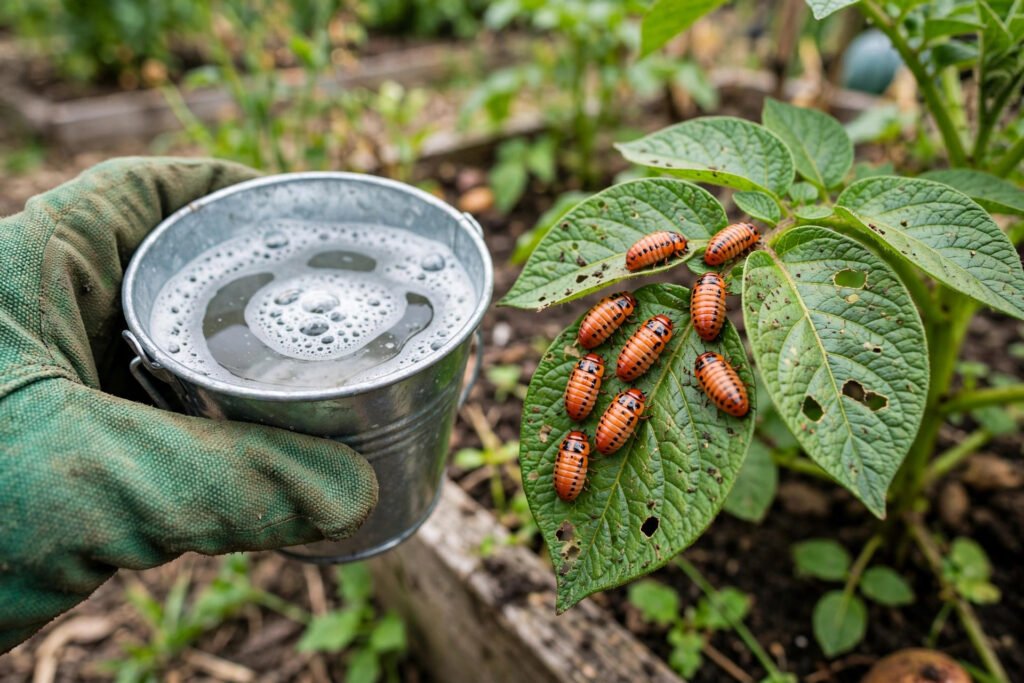
The larvae look very different from the adults, and they are the stage that does most of the damage. Young larvae are brick red with black heads when they first hatch, and they slowly turn pink or salmon coloured as they grow, while keeping two rows of dark spots along each side of their body. A full grown larva is about half an inch long, and it is plump and soft, with a humped back that makes it look swollen.
The eggs are small bright yellow to orange ovals, and the females lay them in clusters of about twenty to forty five on the underside of the leaves. If you turn a leaf over in June and find a neat cluster of orange eggs, you have found the Colorado potato beetle before it has had a chance to eat a single leaf.
Colorado potato beetle life stages at a glance
The table below puts the four life stages side by side, so you can recognise the Colorado potato beetle whatever you find on your plants.
| Life stage | What it looks like | Where to find it |
|---|---|---|
| Adult | Oval, 3/8 inch long, yellow wing covers with 10 black stripes | On leaves and stems, from spring emergence |
| Eggs | Bright yellow to orange ovals in clusters of 20 to 45 | Underside of leaves |
| Larvae | Brick red when young, pink to salmon when older, two rows of black spots | Tops of plants, feeding on leaves |
| Pupae | Oval, cream to orange | In the soil under the plants |
When does the Colorado potato beetle appear?
Colorado potato beetle adults spend the winter buried five to ten inches underground in potato fields, field margins, windbreaks and gardens. They become active in the spring at about the same time that potato plants emerge from the ground, and they walk straight to the nearest potato plants to feed and mate. The females lay their egg clusters on the underside of the leaves, and the eggs hatch within one to two weeks, depending on the temperature. The larvae feed for ten to thirty days, and then they drop to the ground, burrow into the soil and pupate before emerging as new adults.
In warmer parts of the country there can be two or three generations in a single season, while cooler regions usually see one full generation and a partial second one. That is why the Colorado potato beetle seems to come in waves, because the spring adults produce a summer generation that arrives just as the plants are flowering and starting to fill out their tubers. The best time to start looking is the week your potato shoots first break the surface, because catching the spring adults early keeps the whole season easier.
Can the Colorado potato beetle kill a plant?
Yes, potato beetles can kill a plant, but only when the leaf loss is severe and it happens at the wrong time. A potato plant can usually tolerate up to thirty percent defoliation before flowering, because it still has enough leaves to feed the growing tubers.
Once the plants start to flower and the tubers begin to bulk up, the same plant can only tolerate about ten percent defoliation, so the timing of the attack matters more than the number of beetles. The fourth stage larvae do most of the damage, because Utah State University Extension notes that the last larval stage causes most of the feeding damage, and a large group of them can strip a plant in a day or two.
Small plants are the most vulnerable, because a young plant has only a few leaves to lose, so an early attack can set the whole plant back or kill it outright. A mature plant with a heavy infestation can still survive, but the harvest will be smaller, because the tubers stop growing when the leaves are gone. The beetles also feed on tomato, eggplant and pepper, because all of these crops belong to the nightshade family, so a bad year on potatoes can spill over onto your other beds.
How to get rid of potato beetles without chemicals
Chemical sprays are not the first step against the Colorado potato beetle, because this insect has built up resistance to more than fifty different insecticides, and many garden sprays simply do not work on it any more. The steps below follow the integrated pest management order that Extension services recommend, and they start with the simplest actions and move to stronger ones only when the beetles are still winning.
- Scout your plants twice a week from the day they emerge, and look at the underside of the leaves as well as the tops. The larvae prefer to feed at the tops of the plants, so a quick walk down the row with a glance at the growing tips will catch most problems early. Small populations are far easier to manage than large ones, so the goal is to find the first beetles before they have had time to lay eggs.
- Handpick the adults and larvae into a bucket of soapy water, and do it in the morning when the beetles are slow and easy to catch. Handpicking the Colorado potato beetle works best in a small garden, and it is most effective when you catch the adults coming out of their winter hiding spots in spring. Keep at it for a week or two while a flush of larvae is hatching, because one pass will not catch them all.
- Crush the egg clusters or pull off the leaf that carries them, and drop the leaf into your bucket. A single female can lay around three hundred and fifty eggs in her lifetime, according to North Dakota State University Extension, so every cluster you remove in June is hundreds of hungry larvae that never hatch.
- Cover young plants with a floating row cover as soon as they emerge, and seal the edges with soil so the beetles cannot crawl underneath. Row covers work best on small plants in a bed that was free of beetles the year before, because a cover only helps when the beetles are coming from outside the bed rather than waking up in the soil beneath it. Take the cover off when the plants start to flower, so the pollinators can reach the blooms.
- Mulch between the plants with a thick layer of straw, because mulch makes it harder for the adults to reach the plants and for the larvae to drop down and pupate in the soil. Mulch also keeps the soil moist and cool, which helps the plants grow through a light attack. Our guide on how to hill potatoes explains how hilling and mulching work together around the stems.
- Rotate your potato beds, and do not plant potatoes, tomatoes, peppers or eggplants in the same spot for three to four years. The beetles walk rather than fly when they first emerge, and they cannot move very far before the weather warms up, so a new spot each year means many of them die on the trek to find food. Our beginner guide on how to plant potatoes covers rotation as part of planning the bed.
- Plant an early maturing variety, and check seed catalogues for varieties that mature in less than eighty days. An early variety can be well grown before the summer generation of beetles peaks, so the plants escape much of the worst damage. Our guide on early, midseason and late potatoes explains how maturity dates change the timing of the harvest.
Do row covers stop potato beetles?
Yes, row covers can stop the Colorado potato beetle, but only when they are put on early and sealed properly. The cover has to go over the plants as soon as the shoots emerge, before the spring adults have found them, and the edges have to be buried in soil all the way around, because the beetles will walk in through any gap. A cover also fails when the beetles spent the winter in the soil inside the bed, because then they wake up underneath the cover with the plants.
That is why row covers work best together with rotation, so the beetles are not already waiting in the bed when you plant. Once the plants start to flower, lift the cover off, because the plants need pollinators and airflow, and by then the plants are big enough to handle a light attack. If you only use one trick from this guide, make it the combination of early covers and handpicking, because the two together catch both the beetles that slip past the cover and the ones that were already inside.
What about neem, Bt and spinosad?
When handpicking, covers and rotation are not enough against the Colorado potato beetle, a few labelled products can help, but they work only on young larvae, and they do not kill eggs, pupae or adults. The bacterium Bacillus thuringiensis var. tenebrionis, usually sold as Bt, is effective on first and second stage larvae, and it does a progressively poorer job on larger larvae, according to the University of Minnesota Extension. Spinosad is another Extension listed option, and it works best when it is sprayed while the larvae are still small, because large larvae and adults are much harder to kill.
Neem oil, which is sold as azadirachtin, is listed as an option in some Extension guides, but the evidence for it is weaker, and it can harm beneficial insects and pollinators when it is sprayed on open flowers. The honest answer is that neem sometimes helps against very young larvae, and it often does very little against a heavy infestation, so it should never be the first thing you reach for.
Whatever product you use, read the label and follow it exactly, and use it only on potatoes, because a product that is safe on one crop is not always safe on another. Never spray the same product all season, because the Colorado potato beetle has developed resistance to more than fifty insecticides, and repeated use of one product speeds that resistance up. Rotate to a different type of product, or go back to handpicking, rather than spraying the same thing again and again.
Mistakes that make the problem worse
The most common mistake is waiting until the plants are half eaten before doing anything, because by then the larvae are large and almost nothing works on them except handpicking. Another mistake is spraying a general insecticide at the Colorado potato beetle and assuming the problem is solved, because the Colorado potato beetle is resistant to many common garden sprays, and a spray that kills the beetles also kills the lady beetles and stink bugs that eat their eggs. Leaving old potato vines and cull potatoes in the garden over winter is a third mistake, because the beetles overwinter in that debris and in the soil around it, so a messy autumn means a heavy spring.
Planting potatoes in the same bed year after year has the same effect, because the beetles wake up right where the food is. And do not confuse this beetle with a lady beetle and leave it alone, because the striped wing covers are the giveaway, and a lady beetle never chews potato leaves. If you are unsure what you have found, take a clear photo and contact your local Extension office, because a wrong guess can cost you the crop. Our guide on potato blight explains how to tell a pest problem from a disease problem, because the two need very different responses.
Keep the Colorado potato beetle down next year
The work you do in autumn decides how many beetles you will see next spring, so do not stop when the harvest is in. Pull up every potato vine after harvest, and pick up any small tubers and cull potatoes that were left in the ground, because the beetles overwinter in that material.
Clear out nightshade weeds and ground cherry plants near the garden, because these weeds give the spring adults a meal before your potatoes emerge. Move the potato bed to a fresh spot next year, and keep tomatoes, peppers and eggplants away from the old bed as well, because the beetles feed on all of them.
A clean, rotated garden does not guarantee a beetle free year, because new adults can fly in from a neighbour’s garden, but it does mean you start the season with far fewer beetles of your own. Our guide on when to harvest potatoes explains how to check whether the tubers are ready, and our guide on how often to water potatoes covers the watering routine that keeps plants strong enough to grow through a light attack.
FAQ
When do beetles appear?
Colorado potato beetle adults appear in spring, at about the same time that potato plants emerge from the ground. They spend the winter buried five to ten inches underground, and they become active as the soil warms up. In most of the United States that means late spring, and a second generation can appear in midsummer in warmer regions.
Should I handpick daily?
Yes, handpicking works best when you do it every day or two while the beetles are active, especially in the first two weeks after the plants emerge. A daily pass takes only a few minutes in a small garden, and it catches the spring adults before they lay eggs and the young larvae before they grow too big to control. Once a week is enough later in the season, when the plants are large and the beetle numbers have dropped.
Does neem work?
Neem oil can help against very young larvae, but the evidence for it is limited, and it does not work on large larvae, adults or eggs. It can also harm beneficial insects and pollinators when it is sprayed on open flowers, so use it sparingly and only when handpicking and covers have not been enough. Bt and spinosad are the stronger Extension listed options, and they also work best on young larvae, so timing matters more than the product you choose.
Do row covers stop potato beetles?
Yes, row covers stop potato beetles when they are put on as soon as the plants emerge and the edges are sealed with soil. They fail when the beetles spent the winter in the soil inside the bed, or when the edges are left open, so covers work best together with rotation. Take the cover off when the plants start to flower.
Will beetles come back next year?
Yes, the Colorado potato beetle almost certainly will, because the adults overwinter in the soil and in garden debris, and new adults can fly in from nearby gardens. Cleaning up the vines and cull potatoes in autumn, rotating the bed, and clearing nightshade weeds all reduce the numbers that return, but no home garden stays free of them forever. The goal is to keep the numbers low enough that the plants can outgrow the damage.