How to plant potatoes is simpler than most beginners expect, and you do not need a big garden to do it well. Potatoes are one of the easiest vegetables for a beginner to grow in the USA, and they reward a small amount of care with a large harvest. You do not grow potatoes from packaged seeds. You plant seed tubers, or pieces of tuber with eyes, in loose, well-drained soil in full sun.
Plant when the soil is workable and at least 45-50°F, usually 2-4 weeks before your last expected spring frost. Plant seed pieces 4-6 inches deep and 10-12 inches apart in rows 30-36 inches apart, eyes up, then hill soil around the plants as they grow. The steps below cover how to plant potatoes from seed to harvest, so you can follow them in order through the season.
Table of Contents
1. Choose certified seed potatoes, not grocery store potatoes
Buy certified seed potatoes from a garden centre or seed supplier. Certified seed is grown to reduce disease, while grocery store potatoes may carry disease and are often treated to stop sprouting. That is why Extension services in Minnesota, Utah, Kansas and North Dakota all give the same advice: start with certified seed. This is the foundation for learning how to plant potatoes the right way. Our full guide explains the difference in plain terms: Seed Potatoes Explained.
Small tubers about the size of an egg can be planted whole. Larger tubers can be cut so each piece weighs about 1.5-2 ounces and has 1-2 eyes. Cut with a clean knife 1-3 days before planting and let the cut surfaces dry and callus in a cool spot. This helps prevent rot in cold, wet soil. If you want to wake the eyes up before planting, our guide to chitting and cutting seed potatoes shows both steps and explains when you can skip them.
2. When to plant: soil temperature matters more than the calendar
Potatoes are a cool-season crop. The calendar date changes by zone, but the soil rule does not: wait until soil 4-6 inches deep is consistently 45-50°F and workable, not frozen or waterlogged. For most gardeners that is 2-4 weeks before the last spring frost. If you plant too early, while the soil is still cold and wet, the seed pieces rot, the shoots come up slowly and unevenly, and the risk of disease goes up. If you plant too late, the plants run into summer heat, tuber formation slows down, and the yield drops.
Check your local last frost date and your USDA zone, and confirm with your local Cooperative Extension if you are unsure. Understanding your frost date is a key part of learning how to plant potatoes in your climate. Use this table to find your window, then follow the steps below for how to plant potatoes in your zone.
| USDA zone | Typical spring planting window | Notes |
|---|---|---|
| 3-4 | Late April to May | Short season, so choose early varieties and plant as soon as the soil allows |
| 5 | Mid to late April | Classic spring window for much of the Midwest and Northeast |
| 6 | Early to mid April | Watch late frosts, because soil temperature still rules |
| 7 | Late March to early April | Earlier, but check soil temperature, not just air temperature |
| 8 | February to March | Plant early to finish before summer heat |
| 9-10 | January to February, or fall planting in mild-winter areas | Heat is the limit, so avoid planting into hot summer soil |
These are guides, not guarantees. Your local last frost date and your local Cooperative Extension advice override a national table. A sheltered, sunny bed warms earlier than a low, shaded spot. Our companion guide to when to plant potatoes covers fall planting and frost protection in full.
3. Prepare the bed: sun, loose soil, drainage
Choose a spot with at least 6 hours of direct sun. Potatoes need loose, well-drained, fertile soil so tubers can expand without becoming misshapen. Work compost into the top few inches, but avoid fresh, uncomposted manure right at planting. Potatoes prefer slightly acidic soil, around pH 5.8-6.5. A soil test through your Extension lab is the best way to know what your soil actually needs, rather than guessing fertilizer. Good soil is the quiet half of learning how to plant potatoes well, because tubers cannot expand in hard, compacted ground.
Do not plant potatoes where tomatoes, peppers or eggplants grew last year. They are all nightshades and share diseases. Rotate to a different bed each year. If your soil is heavy clay or you garden on a patio, growing potatoes in raised beds gives you the same loose, well-drained soil with less digging.
4. How to plant potatoes: step by step
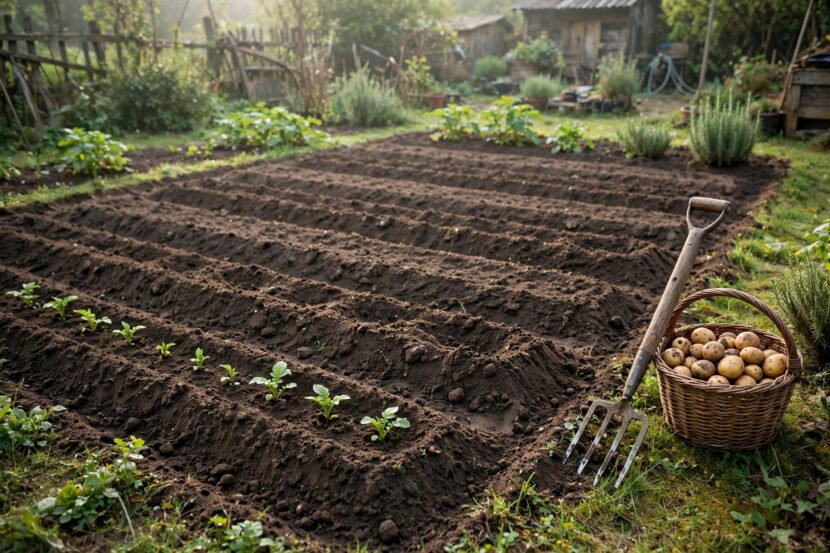
These five steps are the core of how to plant potatoes in any garden bed, and the sections below add the detail.
- Dig a trench or furrow 4-6 inches deep.
- Place seed pieces eyes up, 10-12 inches apart.
- Space rows 30-36 inches apart so you have room to hill and walk.
- Cover with 2-4 inches of loose soil at first, then add more as plants grow.
- Water lightly after planting, and keep the soil moist but not soggy.
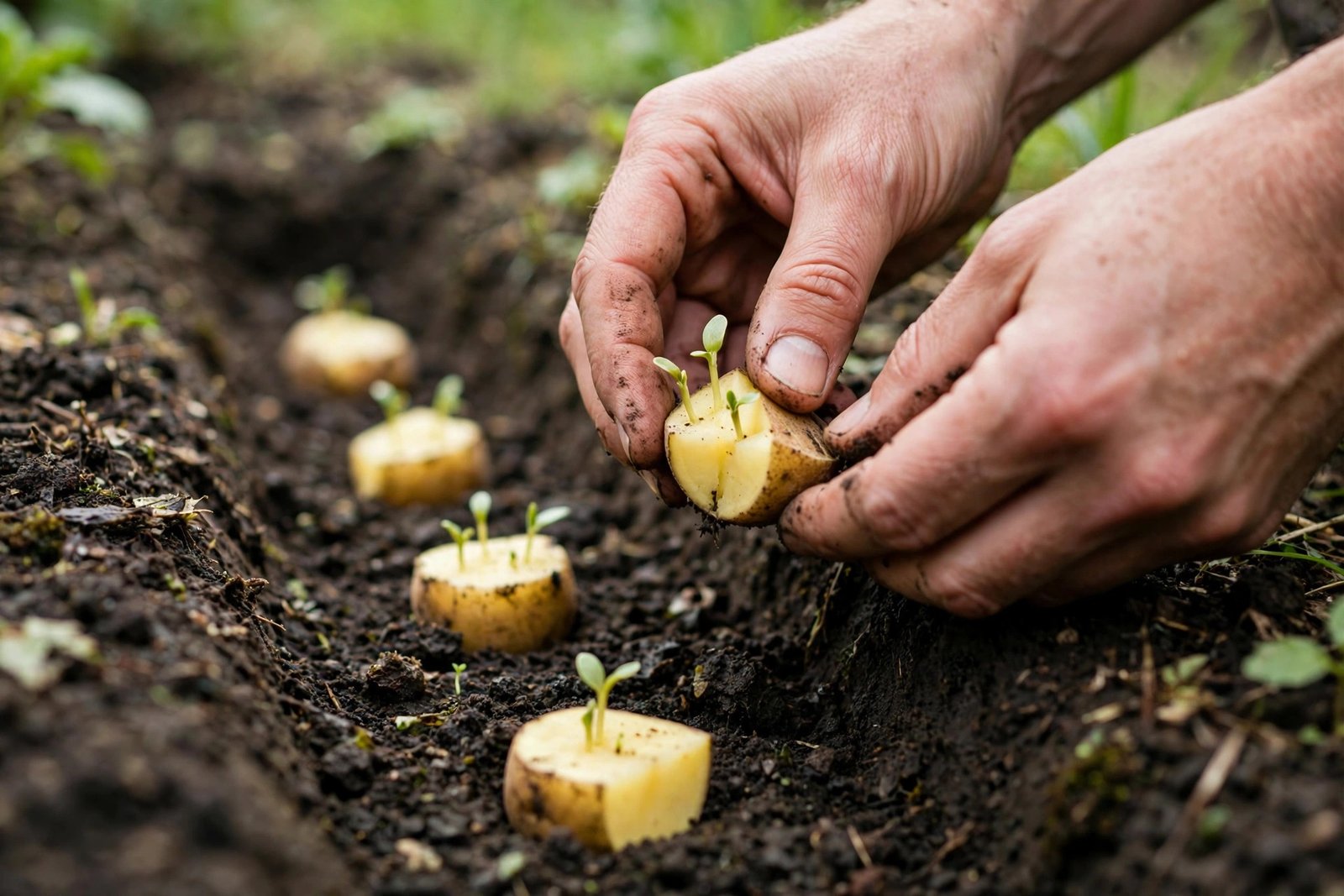
You need roughly 8-10 pounds of seed potatoes for every 100 feet of row. That range comes from Extension planting guides and will vary with piece size and spacing. This estimate helps you plan how to plant potatoes at the right scale for your garden. For the full depth and spacing chart, including raised beds and containers, see how deep to plant potatoes.
5. Hill, water and feed as plants grow
When plants are 6-8 inches tall, pull loose soil up around the stems, leaving just the top leaves showing. Repeat every few weeks. Hilling does three jobs: it gives tubers room to form above the seed piece, it improves drainage around the stems, and it keeps developing tubers covered so sunlight cannot turn them green. Green potatoes contain solanine, a natural toxin, and should not be eaten if heavily green. Our guide to how to hill potatoes shows the timing and the straw method step by step.
Water about 1-2 inches per week, especially when plants flower, because that is when tubers are forming. Mulch helps hold moisture and suppress weeds. Feed according to a soil test. Potatoes are hungry early in the season, but too much nitrogen grows leaves at the expense of tubers. Once you know how to plant potatoes, the weekly jobs are simple, and the full routine is in how often to water potatoes.
6. Growing potatoes in containers
No garden bed is needed to grow potatoes. A large pot, bucket or grow bag on a sunny patio can give a useful harvest, and containers make harvest as simple as tipping the pot out. Use a container of at least 10 gallons with drainage holes, fill it with loose potting mix, and plant one or two seed pieces per container.
Water containers more often than beds, because they dry out faster, and hill by adding mix as the plants grow. Containers are the easiest way to learn how to plant potatoes if you have no garden bed at all. Our guide to growing potatoes in containers, pots and grow bags covers container sizes, soil mix and harvest in detail.
7. Which potato variety should you grow?
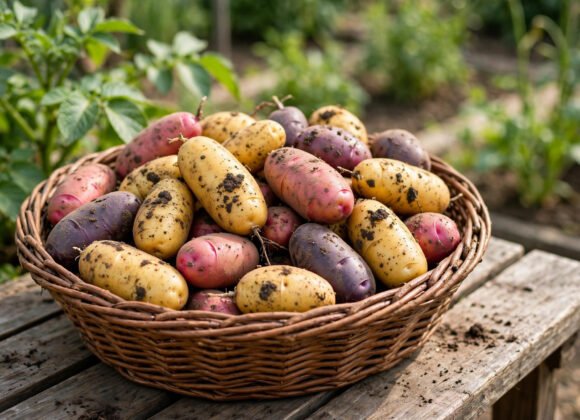
Which variety you plant matters as much as how you plant it. Early varieties finish in 60-80 days and suit short seasons, midseason varieties take 80-100 days, and late varieties need 110 days or more but store longest. Variety choice is part of how to plant potatoes for your own kitchen, because a waxy potato and a floury potato cook very differently. If you want colour on the plate, purple potatoes grow just like other potatoes.
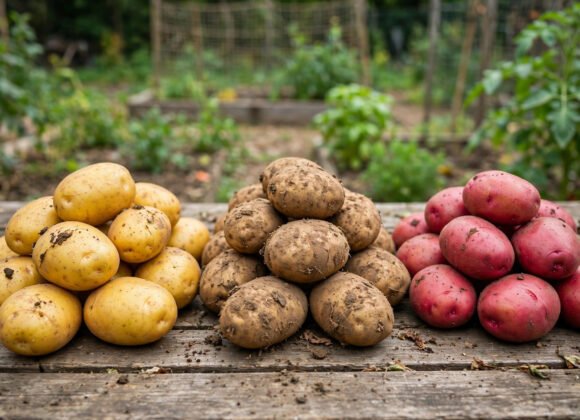
If you like small, waxy tubers for roasting, fingerling potatoes are an easy first grow. For the three most common supermarket types, our comparison of Yukon Gold vs Russet vs Red potatoes explains which grows best and which holds its shape in cooking. Days to maturity for each type are in early, midseason and late potatoes.
8. What to watch for
Colorado potato beetles, aphids, early blight and late blight are the most common problems in home gardens. Start with certified seed, good airflow, watering at the base rather than overhead, and crop rotation. Handpick beetles early and remove badly blighted foliage. Most problems are easier to prevent than to cure, so the advice in this guide on how to plant potatoes starts with clean seed, good airflow and rotation. For identification and organic control, see our guides to the Colorado potato beetle, potato blight, potato scab and yellow potato leaves, which walks through diagnosis cause by cause.
9. When and how to harvest
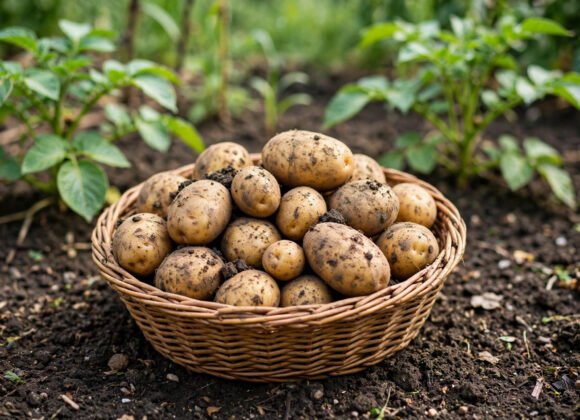
New potatoes can be dug gently 2-3 weeks after flowering, about 7-8 weeks after planting, for small, tender tubers. For mature storage potatoes, wait until vines yellow and die back, then test one hill: mature skins should be thick and firmly attached, not rubbing off easily. Dig on a dry day with a fork, starting at the edge of the hill so you do not spear tubers. Do not wash potatoes before storage.
Cure them first, then store in a cool, dark, ventilated place. Timing the dig is the last skill in learning how to plant potatoes, and the skin test tells you more than the calendar does. Full detail is in when to harvest potatoes and how to harvest potatoes without damaging them.
10. Cure and store your harvest
Harvest is only half the job, because fresh-dug potatoes need curing before they store well. Cure them for 10-14 days in a dark, humid spot at 50-60°F, then move them to a cool, dark, ventilated store at 38-45°F. Well stored potatoes last for months, while badly stored ones sprout or rot in weeks.
Curing and storing finish the job that starts with knowing how to plant potatoes, because a good harvest is wasted if it rots in the bag. Our step-by-step guides to how to cure potatoes and how to store potatoes cover the exact conditions. One safety point is worth knowing before you store anything: potatoes that turned green in the sun contain solanine, so read are green potatoes safe to eat before you decide whether to peel or discard them.
11. How many potatoes will you get?
A realistic harvest is about 1-5 pounds of potatoes per plant, and the number depends on variety, spacing, water and weather rather than on any single trick. A 10-foot row usually gives enough for several family meals, and a 100-foot row can fill a pantry shelf for winter. If your tubers come out small, the cause is usually tight spacing, dry soil while tubers are bulking, or harvesting too early.
Your yield will improve as you repeat the cycle, and that is the real payoff of learning how to plant potatoes season after season. Our guide to how many potatoes per plant gives realistic numbers and works through the small-potato causes one by one.
Quick reference table
| Step | What to do |
|---|---|
| Timing | Soil 45-50°F, 2-4 weeks before last frost |
| Depth | 4-6 inches |
| Spacing | 10-12 inches apart, rows 30-36 inches apart |
| Sun | 6+ hours direct sun |
| Water | 1-2 inches per week, steady at flowering |
| Varieties | Early 60-80 days, midseason 80-100 days, late 110+ days |
| Harvest | New: 2-3 weeks after flowering. Mature: after vines die back |
More potato guides from Homeland Gardening
This pillar brings the whole series together, so if you arrived here looking for how to plant potatoes, the guides below take you deeper into each step.
Planting basics
- When to Plant Potatoes in the USA
- How Deep to Plant Potatoes and How Far Apart
- Seed Potatoes Explained
- How to Prepare Seed Potatoes: Chitting and Cutting Before Planting
Soil, water and care
Varieties
- Purple Potatoes: Varieties and Growing Tips
- Early, Midseason and Late Potatoes
- How to Grow Fingerling Potatoes at Home
- Yukon Gold vs Russet vs Red Potatoes
Pests and diseases
- Potato Blight: Early Blight vs Late Blight
- Colorado Potato Beetle: Identification and Organic Control
- Potato Scab: Causes and How to Prevent It
- Why Are My Potato Leaves Turning Yellow?
Harvest, storage and yield
- When to Harvest Potatoes
- How to Harvest Potatoes Without Damaging Them
- How to Cure Potatoes for Storage
- How to Store Potatoes So They Last for Months
- Are Green Potatoes Safe to Eat?
- How Many Potatoes Per Plant?
FAQ
How long do potatoes take to grow?
Early varieties take about 60-80 days, midseason about 80-100 days, and late varieties 110 days or more, depending on variety and weather.
Can you grow potatoes from a grocery store potato?
It is not recommended. Store potatoes may carry disease and are often treated to prevent sprouting. Certified seed potatoes are the reliable choice.
Do potatoes need full sun?
Yes. At least 6 hours of direct sun gives the best tuber growth. Shade gives leafy plants and few tubers.
Should seed potato eyes face up or down?
Face them up. Sprouts grow upward more easily, and the plant establishes faster. This small detail makes a real difference in how to plant potatoes for even emergence.
How do potatoes grow?
A potato plant grows from a seed tuber, not from a true seed. Each eye on the tuber sprouts a stem, and new tubers form on underground stems called stolons. The plant flowers, the vines grow tall, and the tubers swell underground until the vines yellow and die back. That dieback is the signal that the crop is ready to dig.